28 September 2026

Speak to one of our experts.

30 April 2026
Share:


General
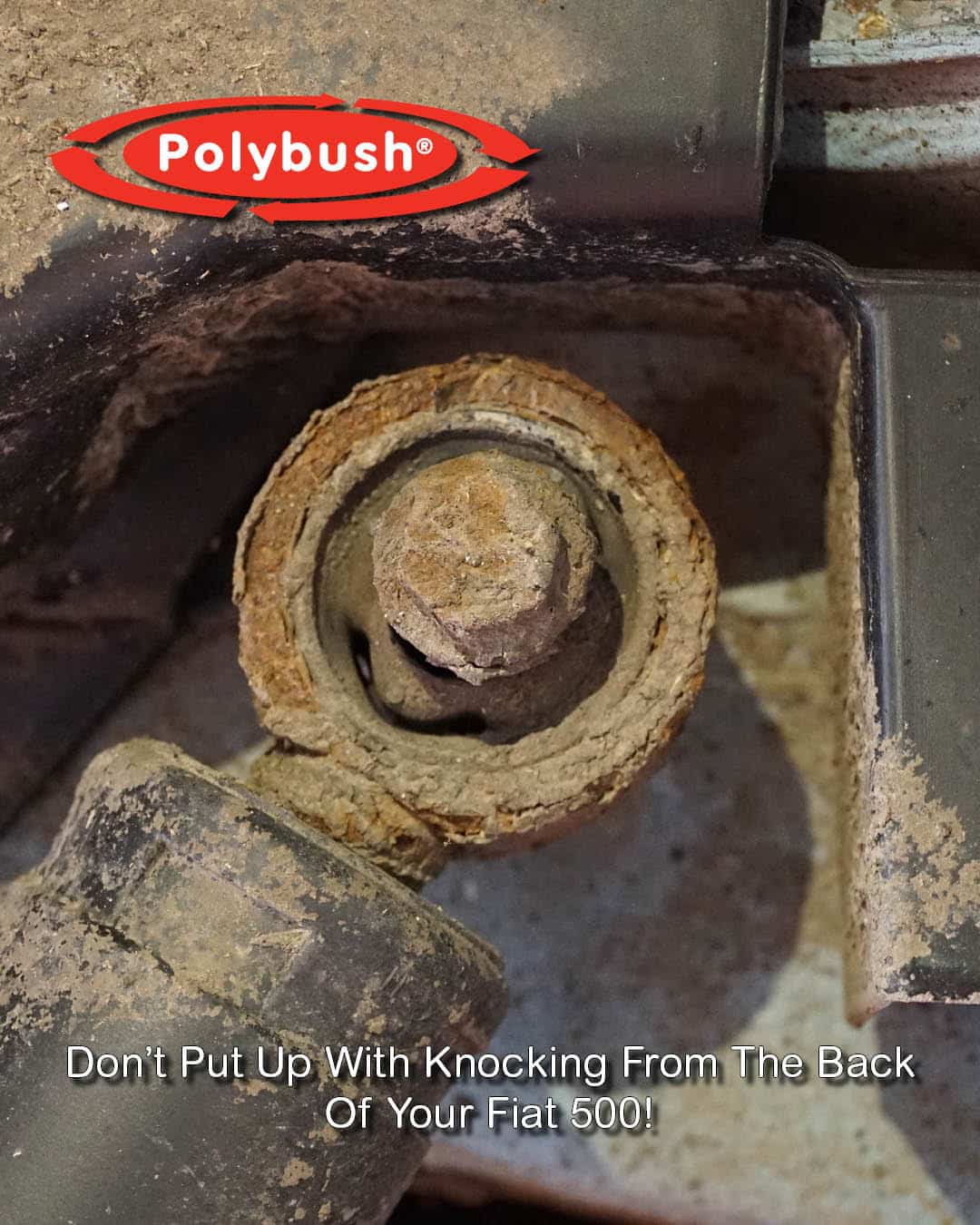
If you’re chasing a rear-end knock on a Fiat 500, 500C or Abarth 312 or Abarth 312C, there’s a very high chance the issue is coming from the rear upper shock absorber bushes. These small rubber mounts sit at the top of the rear dampers and play a critical role in keeping the suspension controlled, quiet and properly located.
On paper, they’re simple components. In reality, they’re one of the most common failure points on this platform.
The rear upper shock bush is responsible for:
On the Fiat 500 / Abarth 312 platform, these bushes (including OEM references such as 51857841, 51864833, 81857840, 51860150, 51857842, 50709731, 1540225, 1578532, 1672372, 9S51-18125-AB / AC / AA) are relatively small and made from soft rubber compounds designed primarily for comfort.
That’s where the problems begin.
The most common issue is compression set, where the rubber permanently deforms under load.
Once this happens:
This is what produces the familiar rear knocking noise over bumps.
Over time, rubber naturally degrades due to:
As the rubber hardens, it loses its ability to absorb vibration, cracks begin to form, and the structural integrity is reduced. This is what turns a flexible and comfort-driven bushing into an unconstrained failing bushing.
The Fiat 500 platform may be small, but it is exposed to significant suspension loads due to its short wheelbase, potholes and speed bumps in urban driving and aggressive compression and rebound cycles from the state of the roads in the UK and Europe – Combined with ‘enthusiastic’ driving found in Abarth models, these repeated shock loads cause internal tearing of the rubber, leading to splitting around the inner sleeve, separation from the outer housing, & knocking from the rear of the vehicle.
One of the biggest issues is that failure is gradual:
By the time the noise is obvious, the bush is often already significantly compromised.
Common driver complaints include:
These symptoms are often misdiagnosed as shock absorber failure, when in reality the damper is usually fine — it’s the mounting bush that has collapsed.
Standard replacement rubber bushes typically replicate OEM design characteristics:
As a result, repeated failure is common on high-mileage or frequently driven vehicles.
Upgrading to polyurethane significantly changes how the suspension behaves under load.
The 24Y Rear Shock Absorber Upper Bush is designed to address the core weaknesses of the OEM design by:
Rather than degrading over time like rubber, polyurethane retains its structural stability, helping to maintain predictable handling and eliminate knocking caused by excessive bush movement.
Rear upper shock bushes on the Fiat 500 and Abarth 312 platform are a known weak point due to their size, material composition and constant exposure to shock loading. Failure typically begins with compression set and progresses into tearing and loss of location, resulting in rear-end knocking and reduced suspension control.
Addressing this component properly is key to restoring rear-end stability and eliminating persistent suspension noise.
For a long-term solution, BUY NOW!